Denali Crampons
I’m using high-and-dry downtime to look ahead to spring expedition season. Going back to Denali in 4.5 months. As I noted years back, the crampons I used for a ski trip on Denali in 2022 were inadequate. I didn’t expand much then, nor did I propose any specific solutions. I’ll do that here and now. Basically, there are some special criteria for crampons when skiing Denali. Special criteria as compared to climbing Denali (we will almost certainly go into more serious terrain with icier footing on a ski trip than we would on a standard climbing trip) and specific criteria as compared to ski mountaineering elsewhere (mainly, overboots. But also those aforementioned icy conditions… high on Denali is icier than most places that most people ski).

World-class, aspirational ski terrain on Denali. Find the three skier dots threading through the ice patches. It might not look this icy when you are there, but that ice is surely underfoot. No matter what it looks like. This is serious climbing terrain; we need serious climbing tools.
So, what do you need and why? First, a ranked list of the priorities for crampons. Most important first, less important as we go on. Inversely, it gets easier to meet the requirements as we go on.
1) Crampon-boot Security.
You need your crampons to stay affixed to your boots, no matter what. If they rattle loose in use, nothing else matters. Boot size, boot shape and crampon design have to work together. Adding overboots (a Denali necessity) very much further complicates crampon security. What is secure on your boots, might not work at all with overboots involved. I find that “hybrid” binding types (basket toe, lever heel) are most secure on over-boot equipped ski boots. But others have found success with “automatic” binding types (wire toe bail, lever heel). Some have even found fully “universal” bindings (basket toe, basket heel) to feel most secure once they put overboots on. The wide variation in experience is due to the myriad geometries of crampons and boots, multiplied times all the different sizes of boots. Boots in the middle of the size curve are easier to fit than the very large and the very small; crampons are simply optimized for these more common sizes. Advice? Choose crampons that are modular in their binding type and try all the combinations, focusing first on security with overboots.
These crampons are too loose. Not acceptable. I’m applying a great deal of force to make them move like this. Climbing also applies a great deal of force. Really try and twist the crampons off in your testing.
2) Size Adjustments
You need crampons that are readily and cleanly adjustable, to discrete and repeatable lengths, without tools. This means a rigid center bar secured with a spring-loaded pin system. Strings and straps need not apply. Of course, no screwdrivers. Swapping back and forth between overboots and sans overboots will necessitate these easy, regular adjustment.
3) Point Geometry.
You need 12 full size, fixed points on your Denali crampons. Non-negotiable. I learned this the hard way, but got lucky. No 10 point crampons. No shrunken points. No modular front points (as featured in technical waterfall ice crampons). Front points can be oriented horizontally (better) or vertically (acceptable). Don’t let front points stick out too far or too little.
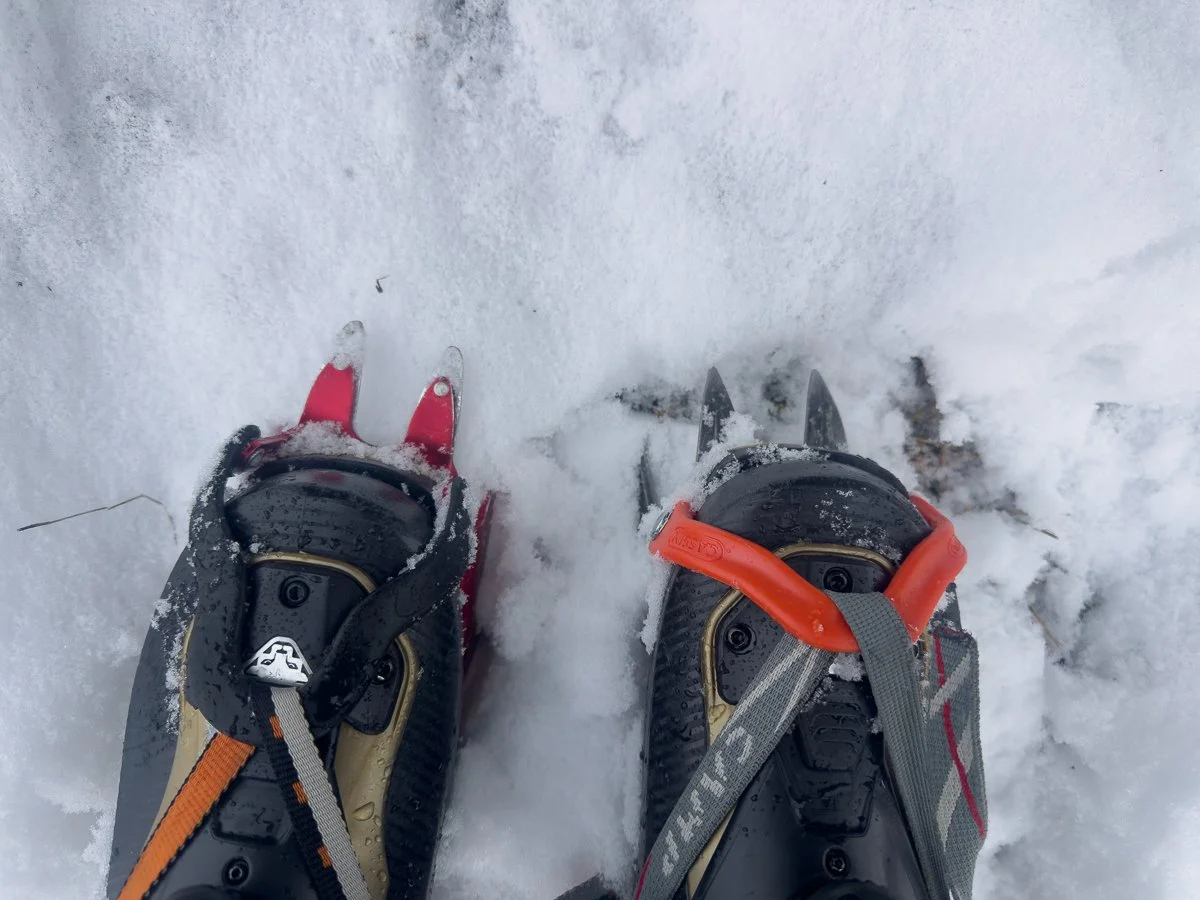
Front points on the left stick out too far to the front. Tripping hazard. And these are non-adjustable. That crampon won't go to Denali. On the right, a much better fit.
4) Material
Steel is best, but some aluminum crampons are acceptable. Aluminum is mainly used to save weight. The real pro move is to have steel front sections and aluminum heel pieces. To save some weight without compromising security and reliability. Other high ski mountaineers are more dogmatic and insistent on recommending all steel crampons. Yes, most aluminum crampons feel a great deal less secure underfoot than most steel ones. But, as weight-saving pieces, most aluminum crampons are also made with fewer and/or shrunken teeth. It is my experience that the insecure feeling of most aluminum crampons is attributable to the number of points on most of them rather than something inherent to the material itself. Full scale crampons made with aluminum are quite secure on snow and ice.
5) Anti-Balling plates
Don’t take them off to save weight; it’s not worth it. That said, if the only crampons you can make work by the above criteria don’t have anti balling plates, that’s ok.
6) Weight
Not important. If you narrow it down to 2 crampons that are equally secure and have full point sets, then maybe you can consider the lighter ones. The only reason I mention aluminum as being an acceptable choice above is that, perhaps, aluminum crampons are more secure on your boots than any other steel choice. Low likelihood, but hopefully that illustrates the importance of boot-crampon security.
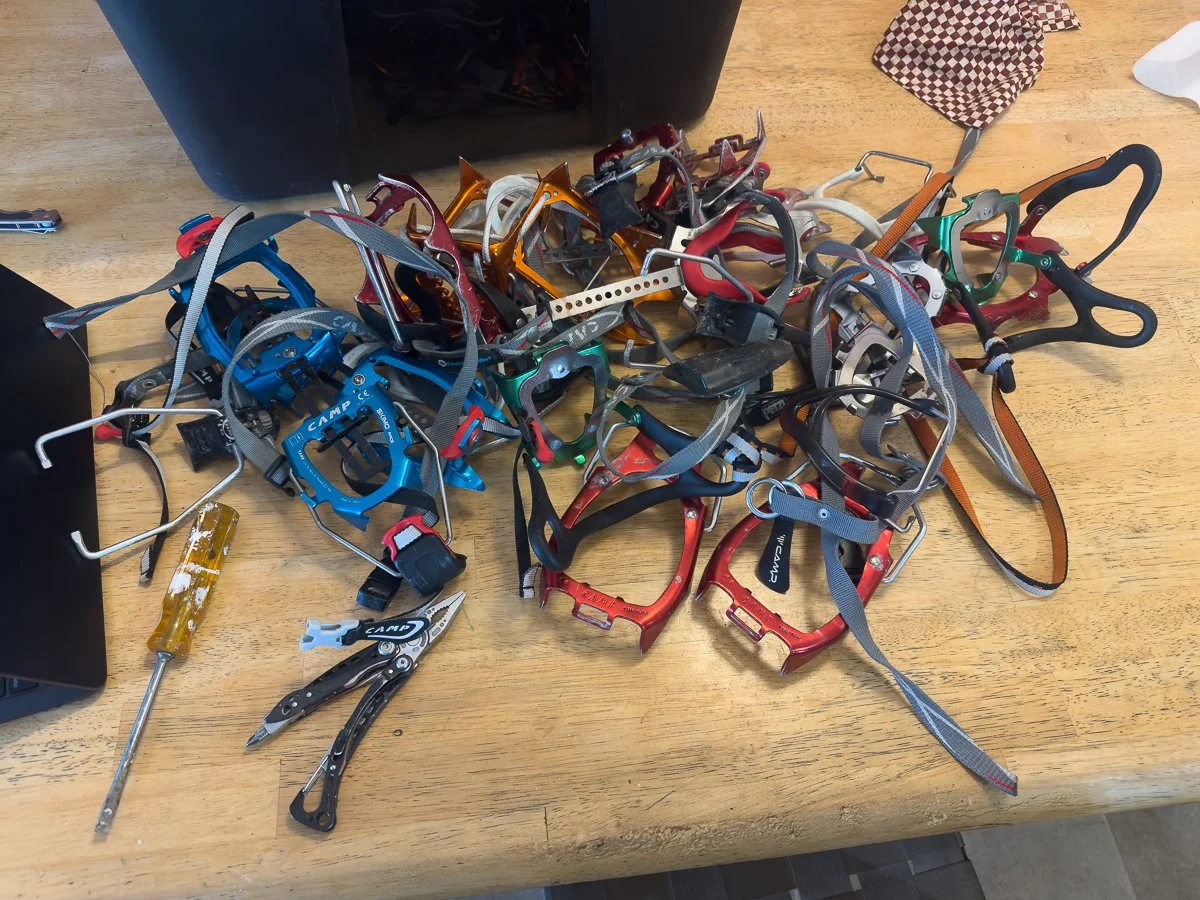
This is worth some time, fiddling, and investment in parts and such.
Specific Recommendations
It is definitely easiest to list the suitable crampons on the market than it is to enumerate those which are inappropriate; most crampons don’t pass some of the important criteria above.
Probably the best product on the market right now that meets all of the above is the Petzl Vasak. It has 12 full size steel points and tool-less adjustment. What really sets it apart, though is the ready availability of different attachment modes. One can buy every part of every Petzl crampon as a stand-alone “accessory”. Buy the Vasak in its normal configuration and also add the “Back Flex” accessory. With these two purchases you can try all the possible binding configurations. Yes, this is easy and could work quite well. But it also might not be secure on your boots and overboots; don’t settle for the Vasak if it is at all wobbly.
Grivel G12 “Dual Matic Evo” is much like the Vasak. Chances are good that one of the configurations of this particular model will work for you. But it looks hard to get ahold of the heel basket type accessory.
In the Black Diamond line up, the Sabretooth is the only appropriate consideration. However, it doesn’t allow for the same modularity that the Petzl or Grivel does.
Blue Ice makes all the right parts, but it isn’t clear if you can buy the right parts separately right now. The crampon you’d want from their line-up is the Griffin. But trying different binding systems might be difficult.
CAMP does not currently make anything ideal. The “Stalker” crampons with semi-automatic bindings might work great. But, if they don’t you don’t have modular options. The CAMP XLC Nanotech crampons are the best aluminum crampons on the market; they have 12 full size points. However, configuring them to adjust without tools and allow for different binding type trials is a Frankenstein project, to put it mildly.
Speaking of “Frankenstein Projects”, my Denali crampons are exactly that. Pieced together from multiple different models. I’ve got an embarrassing number of CAMP crampon parts (12 years of sponsorship will do that) of many vintages. What I got is something I know will work very, very well. But is also virtually impossible to replicate.
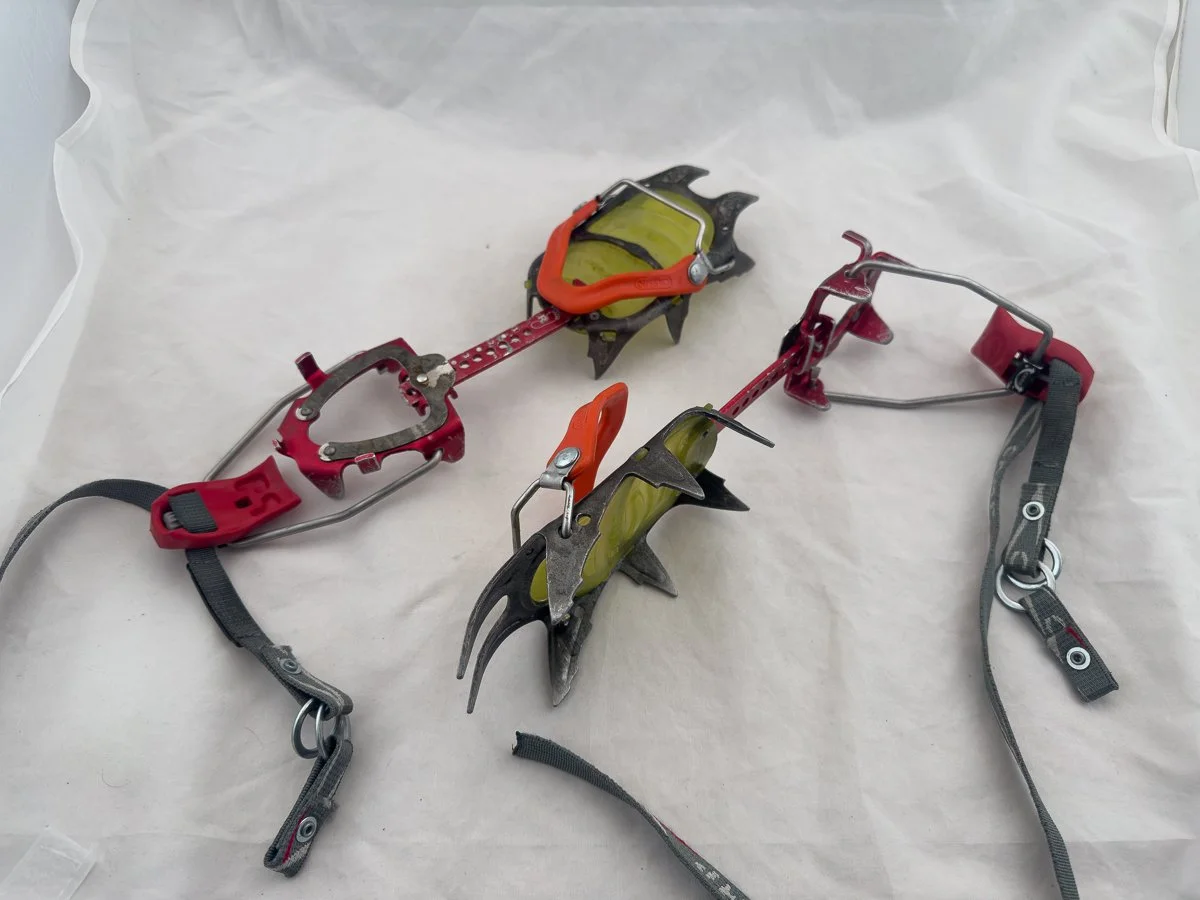
There’s parts here from at least three different crampon models. Some of which are now discontinued.
A Final Note on Overboot Sizing
Overboots have to fit snug for proper crampon security. In my opinion, the pros at Forty Below are a little cavalier about this. There is a risk of them selling you overboots that are too big. I have size XS overboots for my 26.5 Dynafit Ridge Pro boots. I’ve also readily gotten them onto size 28 Scarpa F1 LT boots. On the Scarpa it was a minor wrestling match at home and even more strenuous when outside and cold. On the Ridge boots it is perfect; easy to do indoors when warm and a minor wrestling match outdoors in the cold.